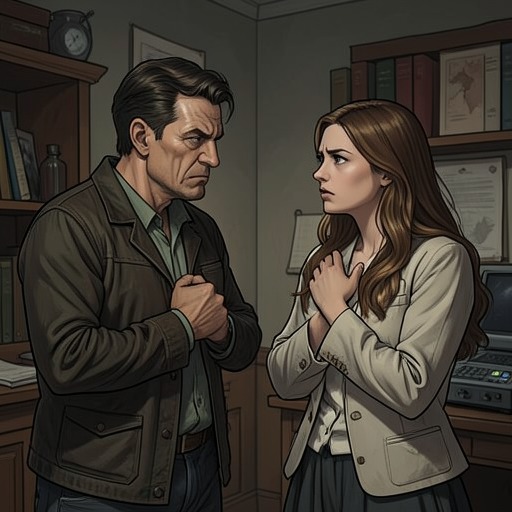
Bane’s mate-fixation on Adrienne
Insatiable Box Set: Books 1-4Bane’s mate-fixation on Adrienne is a volatile attachment that begins under the pressure of law and captivity, then grows into desire, imagined love, and a bid for power. He first spares her because she is pregnant; after meeting her, he wants her as his mate and believes that possessing her could help him defeat Wilder and rule beyond his own pack. The fixation is therefore both personal and political, and its tenderness never removes its coercive foundation.
Origins: Pregnancy, Law, and Captivity
Bane’s first decision concerning Adrienne is not to claim her but to kill her. Her revelation that she is pregnant changes his course: the law he follows forbids killing a female, especially a pregnant one. The shift is decisive but limited. It preserves Adrienne’s life without granting her freedom, and Bane’s conduct continues to place her under his control.
That coercion is concrete. In a cave, Bane ties Adrienne’s hands behind her back, binds her ankles, and secures her waist to a crude chair made from tree branches. He tells her that she will not be able to run if a large animal enters, while presenting his own ability to hear her as a form of protection. The scene exposes the gap between his claim to guard her and the physical restraint that makes her dependent on him. His later fixation grows inside this unequal situation, not after it has been resolved.
The pregnancy also alters how Bane imagines the future. His pack has had no pups because its werefemales are sterile, and he had previously opposed bringing human females into the pack, considering them inferior to werewolf unions. Adrienne makes that position unstable. He begins to see her as a possible mate and the mother of his pups, turning a rule that initially prevents her death into the starting point of a future he wants to control.
From Intended Destruction to Possessive Desire
Bane’s change is presented as abrupt: after seeing Adrienne, he no longer thinks only of destroying her. He becomes envious and covetous, wants to remove Wilder and his brothers, and connects Adrienne’s possession with control of Wilder’s lands and the possibility of becoming Alpha of Alphas. His attraction is thus bound to ambition. Adrienne is not merely the object of desire in his imagined future; she is also the person through whom he pictures taking power.
The narrative gives this ambition an intimate counterpart. Bane comes to want Adrienne as a devoted and loving mate, as he understands the relationship she has with Wilder and his brothers. His threats can therefore be described as empty in relation to his wish to have her willingly, but they remain threats within the actual struggle over her freedom. His ideal of devotion is a future he imagines for Adrienne, not a choice she has made.
That contradiction unsettles Bane’s view of himself. During the journey north, he thinks that he and Adrienne somehow bonded during the night they slept in the same bed and that he fell in love, while also questioning whether love belongs to a werewolf driven by instinct. He describes himself as wanting to return to his former, more beastlike self once he reaches his rogue pack. Yet his recognition that Adrienne needs care, and his regret at treating her differently from werefemales, show that his conduct has already shifted. He experiences this change as a threat to his identity even as he acts on it.
Coercion, Restraint, and Adrienne’s Refusal
Bane’s behavior does not follow a steady movement from violence to consent. As the Full Moon approaches, Adrienne fears that he will be compelled to take her and believes he lacks Wilder’s discipline. At the hotel, Bane says he wants her to need him and forget Wilder, but also threatens to take her into the Alaskan wilderness, where she would have no choice between him and other wild werewolves. He has removed the telephone cords, limiting her ability to call for help. His professed longing for mutual attachment coexists with the deliberate creation of a situation in which she has fewer options.
There are moments of restraint, but they do not erase this pattern. Bane tells Adrienne that he will not act until she tells him she wants him, and his kiss is initially gentle. She does not return his affection; she remains attached to the Samsa brothers and understands that replacing them would mean losing too much. The scene distinguishes Bane’s hope for a willing bond from Adrienne’s actual response. Her bodily confusion does not establish love or consent, and her expressed attachment remains elsewhere.
Adrienne turns Bane’s own departure into an opening. When he leaves the hotel suite, she finds that the phone cannot be used, dresses in her soiled leather clothes, takes food and a coat, and spots the truck keys. Her attempt to escape directly contests the future Bane has planned for her. The episode makes the central asymmetry plain: he speaks of a mate, while she looks for a way out.
Rivalry with Wilder and Continuing Pursuit
Bane’s fixation becomes inseparable from his rivalry with Wilder. Wilder identifies the danger in Bane’s claim: Bane will not stop searching because he has marked Adrienne as his. Wilder describes his own obligation as protection of his family and says he must act as an Alpha werewolf. In the werewolf order Wilder has inherited and must enforce, Bane’s abduction of another Alpha’s mate demands punishment. The conflict is therefore not simply a contest between two men’s desires; it is also framed as a breach of pack law and a threat to Wilder’s family.
The contrast with Wilder’s claim is visible earlier in the story. Wilder says Adrienne is his mate and that he will marry her, while also insisting that she can leave him, though she cannot take a child who would be endangered by the Ari Kara clan. His position still limits her choices in the matter of the pup, but it differs from Bane’s explicit plan to carry her north and make her choose under threat. Bane’s fixation develops in a world where mating claims and law already shape Adrienne’s safety, yet he uses that world to justify further possession.
Even after Adrienne is back with Wilder, Bane remains drawn toward her. In the forest, he hears her voice calling Wilder’s name during an intimate moment, recognizes it amid the distance and surrounding trees, and understands that Wilder has what Bane wants. The sound leads him down the mountain toward them. The scene turns her voice into a thread connecting the separate spaces of captivity and homecoming: Bane does not hear a summons from Adrienne, but interprets her presence with Wilder as a renewed reason to pursue her.
Significance and Unresolved Threat
Bane’s fixation changes him without making him safe. His initial decision is governed by the prohibition against killing a pregnant female; his later desire includes a mate, pups, control of Wilder’s lands, and supremacy among Alphas. Along the way, he shows care and restraint, and comes to understand his attachment as love, but he continues to threaten, confine, and pursue Adrienne. The coexistence of tenderness and coercion is the defining tension of the state.
The fixation also exposes a conflict between instinct and the possibility of emotional attachment. Bane treats love as something belonging to man, while imagining himself as a creature ruled by instinct; nevertheless, his longing, jealousy, and willingness to alter his behavior around Adrienne contradict that division. The narrative does not resolve the contradiction by making Adrienne reciprocate. She remains Wilder’s mate and the object of Bane’s continuing pursuit, so his imagined bond functions chiefly as a source of danger and as the personal motive behind the wider confrontation with Wilder.